ONLINE TUTORING SPOKEN ENGLISH PERSONALITY DEVELOPMENT AND SOFT SKILLS COACHING CLASSES WORKSHOPS EVENT MANAGER PROJECTS HOMEWORK HELP Online tutoring is the process of tutoring in an online, virtual environment or networked environment in which teachers and learners are separated by time and space. Online tutoring, as a reflection of the diversity of the wider Internet, is practiced using many different approaches and is addressed to distinct sets of users. The distinctions are in online content and interface, as well as in tutoring and tutor-training methodologies. Definitions associated with online tutoring vary widely, reflecting the ongoing evolution of the technology, the refinement and variation in online learning methodology, and the interactions of the organizations that deliver online tutoring services with the institutions, individuals, and learners that employ the services. This form of Internet service is a classical micropublishing situation.
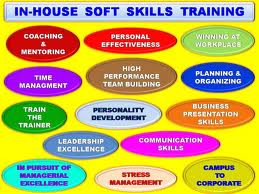
Soft skills is a term often associated with a person's "EQ" (Emotional Intelligence Quotient), the cluster of personality traits, social graces, communication, language, personal habits, friendliness, and optimism that characterize relationships with other people .[1] Soft skills complement hard skills which are the occupational requirements of a job and many other activities. They are related to feelings, emotions, insights and (some would say) an 'inner knowing': i.e. they provide an important complement to 'hard skills' and IQ. Soft skills are personal attributes that enhance an individual's interactions, job performance and career prospects. Unlike hard skills, which are about a person's skill set and ability to perform a certain type of task or activity, soft skills relate to a person's ability to interact effectively with coworkers and customers and are broadly applicable both in and outside the workplace. An individual's personality is an aggregate conglomeration of the decisions they have made throughout their life and the memory of the experiences to which these decisions led. There are inherent natural, genetic, and environmental factors that contribute to the development of our personality. According to process of socialization, "personality also colors our values, beliefs, and expectations ... Hereditary factors that contribute to personality development do so as a result of interactions with the particular social environment in which people live." There are several personality types as Katharine Cook Briggs and Isabel Briggs Myers illustrated in several personalities typology tests, which are based on Carl Jung's school of Analytical psychology. However, these tests only provide enlightenment based on the preliminary insight scored according to the answers judged by the parameters of the test. | FOR ENGINEERING SUBJECTS FOR EVERYONE WHO NEEDS IT PREPLACEMENT TRAINING ENGINEERING SUBJECTS ,GRADE 1-12 DESIGNING , TECHNICAL ,COMMON TOPICS FOR SCHOOLS ,ENGINEERING COLLEGES FOR ENGINEEIRNG STUDENTS ASSIGNMENT HELP TRAINERS OF ROE1. Nancy Mtech ECE 2. Shanthi Mtech ECE 3. Dhanya MBA 4. Divi Mtech ECE 4. Sridhar PhD ECE 5. Kiram Phd ECE 6. Vini Mtech Biotech 7. P.Shanthi Mtech MECH 8. Mili Mtech CSE 9. Priti Mtech CSE 10. Kritik Btech ECE 11. Mahesh Btech ECE 12. Himan Btech ECE 13. Kesav Btech ECE
  |

RUDIMENTS OF EDUCATION prepares your child for success!
 | IntroductionVISION:The College of Education will be a world leader in the integration of (a) teaching and learning, (b) advancement of the knowledge base through research and scholarship, and (c) leadership in service and outreach. Further, the College will be a world leader in preparing professionals who provide leadership and exemplary educational and related services to improve the lives of individuals in a changing and complex global society. MISSION:The mission of the College of Education is to help prepare outstanding educators, scholars, and researchers, and to advance the profession of education, as broadly defined, through research on the science and art of teaching and learning, the application of clinical processes, the effective uses of technology, and the analysis and development of leadership and educational policy |